Friday, 23 October 2015

Museum Visit: Portraits From the Museum Collection and Gerard Richter at the Plymouth City Museum and Art Gallery

I haven't written anything on this blog for ages now due to a creative slump, so I decided this morning that I will pop to the museum in town, see what they have going on and make a quick post talking about the exhibitions on show.


I first went into the room which contained In the Frame: Plymouth's Portraits Revealed. I don't really know what I was expecting, but it was a typical exhibition focusing on portraiture and different forms of it. It was a pleasant experience, even if I didn't particularly learn anything new. The room itself was empty and I enjoyed a couple of minutes of solitude as I quietly shuffled around the space before two people came in and started loudly talking...


I have no special remarks written down about the exhibition - There were some opportunities for public interaction, which is cool, and I did think that the 'blue wall' was quite nice to look at, as you could look at the paintings individually and then step back and appreciate them together from a distance. Also, some of the paintings I have seen in exhibitions in the past, which implies that the museum collection is rather small and the staff do not have a lot to work with; however I do appreciate the effort to educate the people of Plymouth of portraiture and really get the collection out there. 


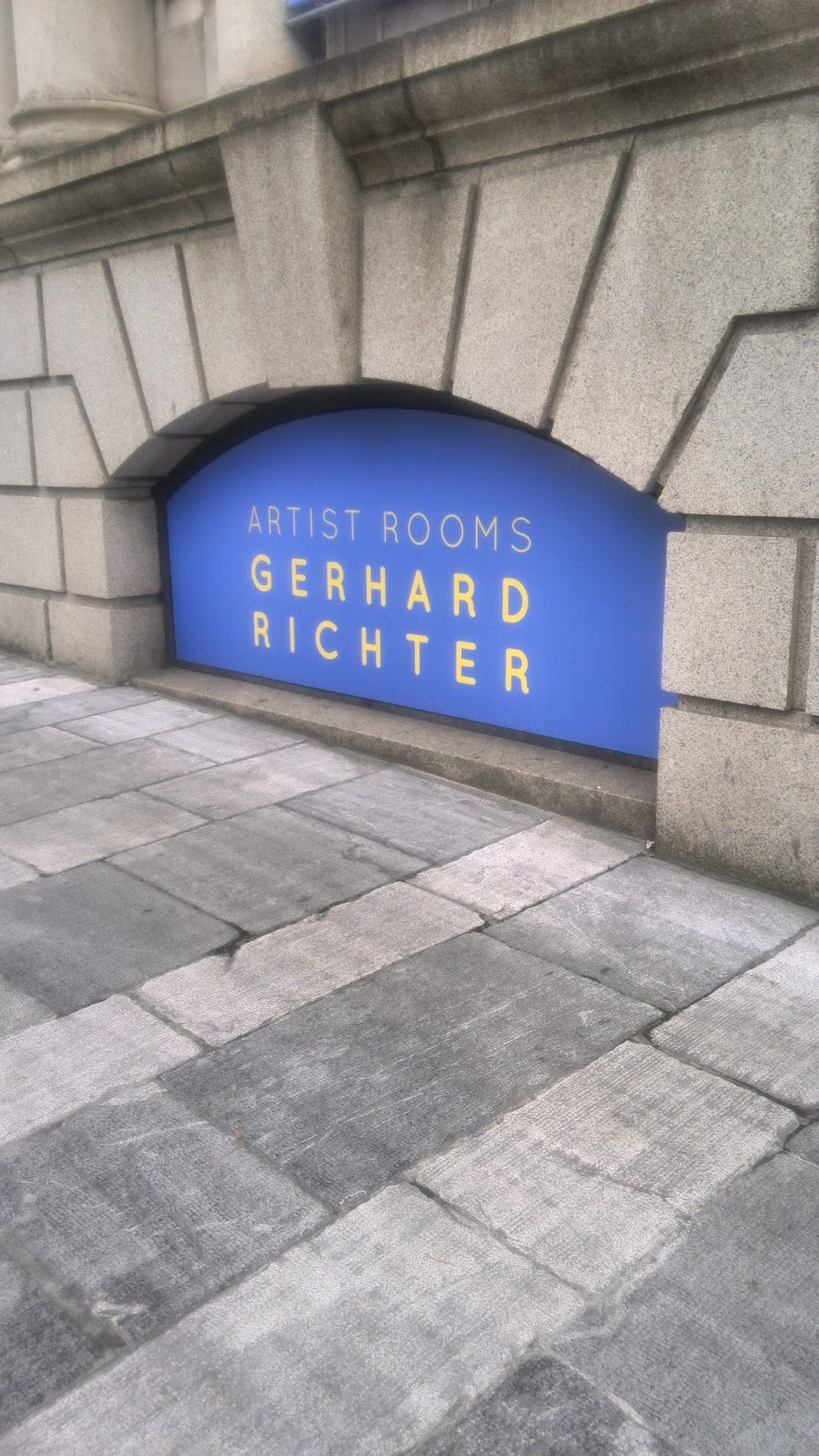
I then went on to have a look at the Gehrard Richter exhibition - ARTIST ROOMS: Gerhard Richter.


Abstract Painting (809-3) by Gerhard Richter
oil paint on canvas, 1994
The show has come to Plymouth as a part of ARTIST ROOMS On Tour which has been organized by Tate. The exhibition "explores his approach to making paintings - where imprecision, uncertainty and chance are as important to the process as composition, imagery and technique. [It] includes one of only four photographic sets in the world based on the series of original paintings Richter contributed to the 1972 Venice Biennale, 48 Portraits. This is shown alongside several other significant works that reveal his diverse practice, from portrait painting to more abstract images, photographs and prints."

48 Portraits by Gerhard Richter
48 photographs, black and white, on paper between Perspex and aluminium board, 1971-98
Gerhard Richter ‘Abstract Painting (Silicate) (880-4)’, 2002
© Gerhard Richter
Abstract Painting (Silicate) (880-4) by Gerhard Richter
oil painting on aluminium, 1991
I quite enjoyed this one, albeit it being a very small exhibition (it was all contained in one single room). There was an interesting combination of music and art which I haven't experienced before in terms of exhibiting; Of course there are installations which combine art practice and music but this was different, as the music played in the exhibition space is separate from the artworks by Richter. It all came together as one as a sort of pseudo Gesamtkunstwerk and I found myself having the experience of looking at art heightened by music at the same time. The music, however, after 10 minutes or so, became slightly distressing and I kind of wanted to make a swift exit so I didn't spend a lot of time looking around - although it did raise some questions about music and art, e.g. would the experience of observing art be improved if all art museums played music in their gallery spaces? What kind of music would be the best, does it have to match the years the art was made in, and does the subject matter of the music have to match the artworks? What about lyrics? And so on, and so on...

There were also extended labels available for people to read and a student response booklet/leaflet/? by students of Plymouth uni and art college, which I thought was pretty cool as well.


There was also an exhibition about the connections of Plymouth and Fiji, and it included a lot of artifacts from Fiji which, well, I'm not completely comfortable with as I would rather the museum repatriate the objects where they have come from... But that's a massive topic in of itself and this post isn't the right place to discuss it.

That is all for this blog post, I have been slowly putting together a plan for a series on Estonian woman artists, so watch this space! In the mean time I might be writing a post or two on random topics just to keep boredom at bay.

ADDITIONAL RESOURCES

Monday, 5 October 2015

Hands and Feet of Duchesses: Bouguereau and the Idealization of the French Peasant


William Adolphe Bouguereau (1825-1905) was a French Academic painter who was a prominent figure in the Salon. He painted a lot of mythological, religious and allegorical pictures which was typical of academic painters of the time. The smooth, neoclassical finish of his paintings and his expert rendition of human flesh had earned him a lot of prizes in his lifetime - he obtained the first Grand Prix de Rome and a scholarship at the Villa de Medici in Rome in 1850, at just the age of 25. He was made Chevalier of the Legion of Honour in 1859 and a member of the Académie de Beaux-Arts and Officer of the Legion of Honour in 1876. He was also appointed a professor at the École de Beaux-Arts in 1888 and made Grand Officer of the Legion of Honor in 1902.

The Virgin with Angels by William Adolphe Bouguereau (1825-1905)
oil on canvas, 1900
The Birth of Venus by William Adolphe Bouguereau (1825-1905)
oil on canvas, 1879
Portrait of Elizabeth Jane Gardner by William Adolphe Bouguereau (1825-1905)
oil on canvas, 1879
Throughout Bouguereau's career, the world saw the greatest explosion of styles, subjects and experimentation in all of art history including expansion and development both technically and thematically that had ever occurred before since the Enlightenment. The great Academic painters of the 19th century (Cabanel, Gérôme, Alma-Tadema, etc.) were all pushed aside by the new Modernist theory. Bouguereau's painting style and subject matter was everything the Impressionists and Realists loathed. His name became somewhat of a joke, as Degas and his Impressionist friends called very smoothly finished academic paintings "Bouguerated". Van Gogh also disliked Bouguereau. In a letter he wrote to his brother Theo in August 1888 he said that "if we painted like Bouguereau people wouldn't be ashamed to let themselves be painted," and "if we painted like Bouguereau, that we could then hope to earn."

It comes as no surprise that after Bouguereau's death in 1905, the popularity of his work suffered a steep decline due to the rise of the new Avant-Garde ideas and art movements in the early 20th century. His work was considered kitsch and untasteful, and only after the 1970s did it become 'acceptable' to appreciate his works once again.


One genre of painting that Bouguereau was praised for were paintings of peasants. During the aforementioned explosion of styles, subjects and experimentation was a rise of the genre of peasant paintings and changes in attitudes towards them. At first, they were simple, idyllic pictures with strong religious or moral undertones, but the French Revolution of 1848 brought about a change in how people treated peasants and how they were represented in art.

The Milkmaid by Greuze (1725-1805)
oil on canvas, 1780-4?
The Shepherdess by Jean-Honoré Fragonard (1732-1806)
oil on canvas, ca. 1750-2

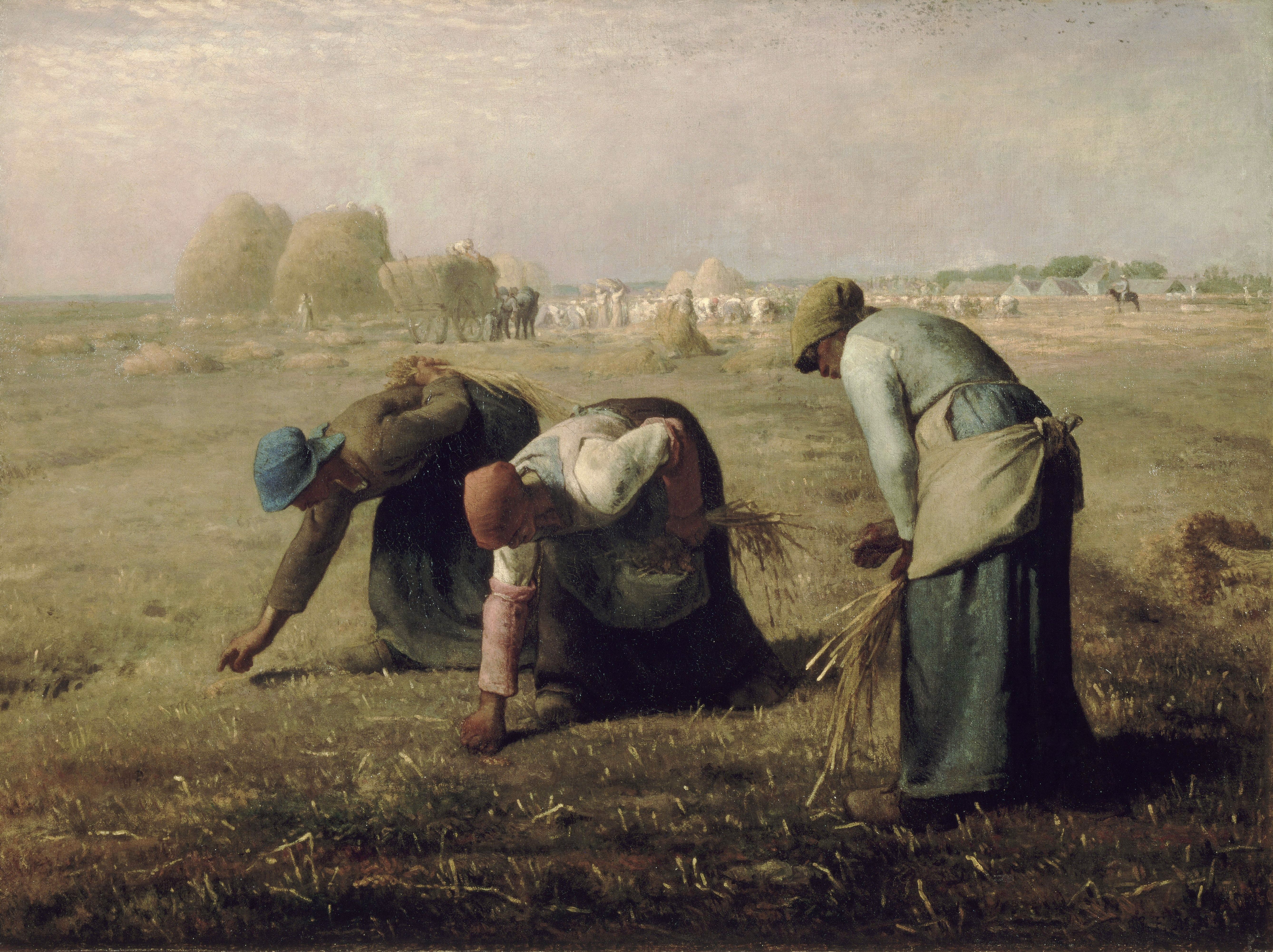
Artists like Millet, Bastien-Lepage and Courbet painted peasants as realistically as possible, warts and all. Many paintings representative of rural life were painted without idyllic and pastoral associations as paintings of peasants became more relevant to modern life. 

October by Jules Bastien-Lepage (1848-1884)
oil on canvas, 1878
The Gleaners by Jean-François Millet (1814-1875)
oil on canvas, 1857

The Stone Breakers by Gustave Courbet (1819-1877)
oil on canvas, 1849
Although a lot of artists preferred to depict the gritty reality of rural life, grand paintings of mythological and historical scenes were still more popular in the Salon. As time went on however, more academic painters had started to depict peasants and the countryside in their art. What begun as a resistance against the Academic style was now a popular and socially acceptable genre. The characteristics of rural life that been thought of expressions of the peasants' victimization were now gone and transformed into civic qualities which was hoped that the urban poor would emulate. 

Rest by William Adolphe Bouguereau (1825-1905)
oil on canvas, 1879
File:Breton - Fille de pêcheur, 1878.jpg
A Fisherman's Daughter by Jules Breton (1827-1906)
oil on canvas, 1878
Thus, the appearance of the peasant in artworks by Academic painters changes yet again. For example, Rest by Bouguereau and A Fisherman's Daughter by Jules Breton are complete opposites to the works of Courbet who made an effort to duplicate the hard life of the peasant on the canvas.

On the ArtRenewalCenter website, in an entry for Rest, Kara Ross writes;
"Though the family depicted in this scene is poor, one can tell that they understand that money does not necessarily buy happiness. The mother tenderly holds her baby with her older son asleep at her feet indicating the joy and peace that can be found in everyday family life and in motherhood. The mother gazes out at her viewers as if to ask how she could possibly need more then she already has, her greatest treasures lying in her arms and at her feet. Bouguereau was a deeply religious man, and the church in the background symbolizes that God rules over the rich as well as the poor, and that all people are children of God and equal in His eyes."
This interpretation of the painting is correct to a certain point, however it completely ignores the fact that the image Bouguereau has produced is an idealized version of the real-life peasant which has sugar-coated the aspects of being a part of the working class. "Money does not necessarily buy happiness": Indeed it may not, but it does buy necessary things one may need to survive and have a comfortable life which can contribute to happiness. 
William-Adolphe Bouguereau (1825-1905) - The Shepherdess (1889).jpg
The Shepherdess by William Adolphe Bouguereau (1825-1905)
oil on canvas, 1889
The Shepherdess by Bouguereau is also a very idealized image of the peasant. The painting depicts a young girl with dark hair in front of a vast landscape, with grazing cattle in a field behind her. It has a peaceful, idyllic atmosphere. She has good posture which makes her look confident, and the hilly landscape behind her and the raised foreground makes it look like she is looking down on the viewer.

Children were a favourite of Bouguereau's to paint. He had young girls from Brittany pose for him in his garden in La Rochelle, calling those paintings either "Little Shepherdess", or "Little Beggar" - whatever he felt like at the time and what kind of a 'vibe' he was getting from the sitter.

Although these 'shepherdesses' and 'beggars' were dressed in simple peasant clothes and didn't wear any shoes, as Louis Sonolet wrote, "they have the hands and feet of Duchesses", which rings true as the skin of the peasants in Bouguereau's painting look too pure, their feet too clean, their hands too smooth, their faces young and free of any signs of a hard life, and their clothes look too fresh, as if they are being worn for the first time. Sonolet also stated that Bouguereau "Never tried either exactly to represent the characters before him or to reproduce the types of a certain class. He made for himself an abstract image of beautiful forms, completely independent, so to speak, of anything that could affect or modify it. In his way of rendering nature a considerable part of it is purely subjective. He never stops with things exactly as they are. He cannot help idealizing all the touches." Bouguereau indeed could not help 'idealizing all the touches', as in an article by Eugene Tardieu he said that "in painting, I am an idealist. I only see the beautiful in art and, for me, art is the beautiful. Why reproduce the ugly things that exist in nature? I see absolutely no need for it, unless it can be done by someone who is immensely talented."

Anyhow, many painters chose children as their subjects, skirting social issues and sugar-coating the hardships of rural life. By choosing children to be the protagonists of their paintings made the works more acceptable to be hung in the homes of the middle and upper classes, as the vulnerable and charming little kids made no overt demands for help and sweeping political reform. These kinds of pictures fit into the sentimental and anecdotal taste of the period.

Shepherds and shepherdesses were also popular subject matters, it’s said that they were regarded as more respectable members of the society. Certain shepherds acquired some sort of a heroic status and had an aura of respectability about them.

William Adolphe Bouguereau (William Bouguereau)
The Little Beggar by William Adolphe Bouguereau (1825-1905)
oil on canvas, 1880
A lot of academic artists who painted peasants painted unrealistic representations of rural life. They were biased by many preconceived ideas derived from their social background, training and what was popular with the critics and patrons. These paintings were painted by the upper classes, for the upper classes. They didn’t want a dirty peasant cowering in a field; they wanted a beautiful woman standing in a field, much like paintings from past centuries where French aristocrats were seen play-acting at being shepherds or their mistresses “merry-making” as milkmaids. The artist was chasing the peasant but couldn’t catch them, instead he got his shadow.

The Dancing Milk Maids by Francis Hayman (1708-1776)
oil on canvas, ca.1735
William Adolphe Bouguereau (William Bouguereau)
The Harvester by William Adolphe Bouguereau (1825-1905)
oil on canvas, 1868
Being from a wealthier background, artists were also able to travel around the world to seek inspiration. As mentioned earlier, Bouguereau was awarded a scholarship in Villa de Medici and the Grand Prix de Rome in 1850- meaning he studied in Italy and undertook a grand tour of Europe. In consequence it is very possible that the rural life of Italy also influenced his work, as he would’ve often made studies from life based on local peasant models.

Italy reminded the French of the classical world, so over the course of the century all manner of Italian costumes and customs also were presented to the public. For example, Bouguereau’s painting Return from the Harvest painted in 1879 has a very religious and mythological feeling to it and is the most inaccurate representation of rural life possible, as there was no French equivalent to the Italian south. These kinds of paintings are very similar to ones in the style of Orientalism, but can also represent artistic escape.

Return from the Harvest by William Adolphe Bouguereau (1825-1905)
oil on canvas, 1878
Linda Nochlin writes that the representation of labour in art had become “feminized” during that time, as there was a lack of ploughmen, sowers and stonebreakers. 

On one hand, the peasant became a modern goddess. More specifically, the Goddess of the harvest, Ceres. There was no sense of contemporaneity that was associated with early Realism. Paintings no longer showed the peasants as suffering victims of exploitation. 

On the other hand, the female peasant became a political symbol. Painters painted a lot of milkmaids and shepherdesses, and Nochlin stated that those kinds of paintings represented the “ideological definitions of femininity” and “the good worker”. The feminized peasant paintings acted as a sister to alternative images of the country, like Liberty, in Delacroix's Liberty Leading the People. They were symbols of calm, productive labour and imagined rural stability. She, like the late Realist peasant woman, successfully encased political modernity within a cloak of “traditional values”.

Eugène Delacroix - La liberté guidant le peuple.jpg
Liberty Leading the People by Eugène Delacroix
oil on canvas, 1830
The implied imagery of the working peasant in the role of a powerful figure could also serve as something that could empower the lower classes, however you cannot deny that Bouguereau's prerogative to sugar coat the reality of peasant life, alongside many other artists who idealized French rural life, played a bigger part in the erasure of the hardships of the lower classes and reinforcement in the upper classes of the idea that the lower classes are happy with being poor, thus releasing them of any guilt that they might be a part of a system that victimizes the poor. 

Sources

Tuffelli, N., 19th Century French Art: 1848-1905, Edinburgh: Chambers Harrap Publishers, 2004

Glueck, G., "Art View: To Bouguereau, Art was Strictly the Beautiful", New York Times, 6 January 1985

"Bouguereau and the Real 19th Century"
https://www.artrenewal.org/articles/Philosophy/TheReal19thCentury/thereal19thcentury.php

http://www.vangoghletters.org/vg/search/simple?term=bouguereau

Bezucha, R. J., "The Urban Image of the Countryside in the Late 19th Century French Painting; And Essay on Art and Political Culture", in Sturges, H,, The Rural Vision: French and America in the Late 19th  Century, Nebraska: Nebraska Press, 1982, pp. 13-21

"William Bouguereau - an Introduction by Fred Ross"
https://www.artrenewal.org/articles/2010/BouguereauIntroduction/BouguereauIntroduction.php

The French Peasant in French 19th Century Art, Exhibition Catalogue by Thompson, J., Dublin, Trinity College, 1980

Author Unknown, Bouguereau: French School, Boston: Bates and Guild, 1906, p. 416

"Bouguereau at Work"
https://www.artrenewal.org/articles/Technical_Articles/WALKER-BOUGUEREAU/WALKER-BOUGUEREAUpage1.php

Sunday, 6 September 2015

Lady photographers of Weimar Germany


Hello all, I just felt like sharing some photography with you tonight.

I wrote an essay in my final year of university for my German art class on the New Woman trope in Weimar Germany and the role female photographers held in regards to it. Like usual, the essay was left to last minute (the night before the deadline) and I didn't exactly know that I was writing about female photographers until I was about half way through the essay... 

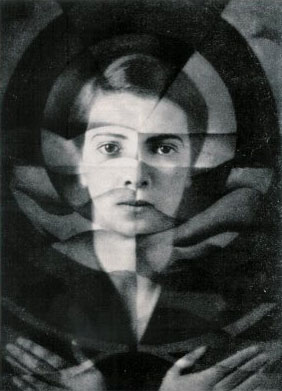
Nevertheless, I discovered some great photographers who took some beautiful pictures. Some of them have this haunting quality to them and they embody the ideals of the modern woman of the early 20th century. What I love about them is that most of the photographers I looked at took a large number of self-portraits, turning the New Woman trope upside-down. The photographers deny the man to construct a fetishized image of women living in Weimar Germany and instead, they present themselves however they want to be seen. 

GERTRUDE ARNDT (1903-2000)

Gertrude is one of my favourite photographers, being a part of the Bauhaus movement (I have a soft spot for Bauhaus). She is mostly known for her series of 43 self-portraits she took in the 1930s.
Read more about her here, here and here


Masked Portrait No. 34, 1930
Gertrude Arndt
Masked Portrait No. 28, 1930
Gertrude Arndt
Masked Portrait, 1930
Gertrude Arndt
Masked Portrait, 1930
Gertrude Arndt


MARTA ASTFALCK-VIETZ (1901-1994)

By far probably my most favourite photographer/artist ever, Marta's work is dark, ethereal, erotic and mesmerizing. She isn't very well known, and material on her is scarce (as I found out, sitting in the university library at 6am...), but you can still find some of her works floating around on the internet if you do a quick search of her name on Google. 

Dr Katherine Tubb recently curated a show of her works in Glasgow, which was Marta's first ever solo show outside of Germany. Tubb writes that the works show a range of personal responses to the social, political and sexual transformations of Germany after World War I. They also provide to be a good example of construction of identity.

Marta Astfalck-Vietz, No.20 Self-Portrait, no date
Self Portrait No. 20, Date Unknown
Marta Astfalck-Vietz
Selbstmord in Spiritus (Suicide dans l'alcool), 1927
Marta Astfalck-Vietz
YVA (1900-1942?)

Yva was born as Else Ernestine Neuländer-Simon, and opened her own photographic studio in 1925. She established herself as one of the leading photographers in Berlin until her forced removal from public life in the late 1930s due to the ultimate intentions of Nazi racial policy.

At her most popular, she produced photos for the growing number of illustrated magazines and periodicals in circulation, like Gebrauchsgraphik and UHU
In 1930, she began contributing photo-stories to the magazine UHU, which were directed at the young female reader, covering many popular themes such as young women arriving in metropolitan Berlin from the countryside and their many trials and tribulations they faced on their road to stardom. These photo-stories allowed Yva to move beyond the limitations of the static photo image and produce highly competent work in an intermediary genre between photography and film. 

Self Portrait, 1926
Yva
Young couple flirting, Man wearing a suit and woman wearing a lace evening gown- Photographer: Yva- Published by: Uhu 9/1932Vintage property of ullstein bild
Published by UHU, 1932
Yva
Yva- Published by: ' Uhu' 2/1932/1933Vintage property of ullstein bild
Published by UHU, 1932/3
Yva
File:Yva Fashion Photo Bathing Suit Modell Schenk c1930.jpg
Ca. 1930
Yva

EXTRA READING ON WOMEN ARTISTS IN THE WEIMAR REPUBLIC
  • Practicing Modernity: Female Creativity in the Weimar Republic by Christiane Schönfeld, Carmel Finnan (partly available on Google Books)
  • Visions of the "Neue Frau": Women and the Visual Arts in Weimar Germany by Marsha Meskimmon, Shearer West
  • We Weren't Modern Enough: Women Artists and the Limits of German Modernism by Marsha Meskimmon (partly available on Google Books)
  • Women in the Metropolis: Gender and Modernity in Weimar Culture by Katharina von Ankum (partly available on Google Books)

Sunday, 3 August 2014

monday night musings on museums


I haven't written a blog post in about a year or so, but that's okay. I was going to make a new blog as I feel like I have all these new ideas in my head swimming around and that this one with its old posts wasn't a suitable platform. But I don't mind having them here I guess, I'd rather have old posts to build upon rather than write an awkward introductory post on a new blog.
That isn't to say that this post itself isn't something of an awkward introductory post ...

I want to talk about museums tonight, more specifically about people's behaviour in art galleries/museums/gallery spaces/etc ... There's an unwritten Code of Conduct that somehow exists and must be followed once you are in the white cube space and if you break it you're seen as an uneducated pleb that doesn't understand art. That's probably why everyone acts the same in art galleries, so that they're seen as smart.

Thomas Struth / Museum Photographs (1989-2000)

It's the same in every gallery I've been to, and I'm certainly guilty of doing the same. People first enter the art gallery, and almost immediately turn to their left. According to some of my art history lecturers who also have curated shows, this is a thing most people do when they enter a gallery space. Anyway.. 
What most people do is walk around the room, in a clockwise direction, slowly, pausing ever so often to read the label beside the artwork or to look at the artwork itself. Nobody really talks, and if they do, they whisper. It's the Code of Conduct of Walking Around Galleries and Looking at Art. 

Midnight in Paris (2011) / jolieing

I believe it's the overall aura of the museum that has become incredibly restricting and has taken the enjoyment out of visiting galleries. This 'aura' I'm talking about is purely imaginative but it's reinforced by the museums acting as surrogate cathedrals with its high ceilings, where the paintings on the walls act as icons and altarpieces. The stark contrast of artwork and the white wall gives the works an ephemeral quality and the quietness in gallery spaces, where only the clip-clop of heels or shuffle of tennis shoes can be heard, supports the idea of the museum space as a church interior. So obviously, museums are treated in a religious manner and not viewed as something that have educational purposes. 

Tate Britain / rimbly
Of course there are going to be people who don't view museums as places of worship but rather as places that are moreso boring and reserved for the higher classes/academics. 
In other words, there's a stigma that surrounds the art gallery (and especially galleries of modern/contemporary art...). 

A child climbs on a Donald Judd sculpture in Tate Modern / Children in Museums: it's the Parents Who Need Training 
With the new generation of the 'millenials' and the '90s kids' I feel like it's our job to challenge the authoritative voice of the museum (but not to the extent that we'd climb into priceless sculpture!!!) by going against the grain of the conventional behaviour in gallery spaces. 

Thomas Struth / Museum Photographs (1989-2000)

Walk around the gallery space for as long as you want. Zig-zag around the room from painting to painting, ignore the people swimming in the space in a clockwise direction. Sit down on the floor, draw the artworks. Get to know them. Come up with stories about the people in the paintings, the shapes of the sculptures, the curiosities of the installation art that nobody really gets. Make up your own meanings. Interpret freely. Don't read the labels (or read the labels?) Write down in a notebook what you like about the gallery space.
Take as little or much time as you want. You don't HAVE to look at all of the artworks in the museum in one visit, you will probably return in the future. Pick up a couple of works you are excited about seeing and look at them in more detail. Contemplate their form, the artists' motives and ideas, or just adore their beauty.

But most of all, don't feel pressured to have some sort of enlightening experience in the gallery. Relax. Have fun. Take it easy. 

Alécio de Andrade / The Louvre and it's Visitors (1965-1994)


Sunday, 14 April 2013

Bonjour Paris!

I went to Paris in the end of March for a day, before going to Amsterdam for about 6 days.
It was very beautiful there, I loved the Architecture. I think I fell in love with about every handsome fella who walked past me! There is just something so quaint and lovely about Paris, and I'm not only talking about the very city centre because my friend and I stayed in a hostel in the outskirts. I daresay the area we were staying at was a little bit more atmospheric than the rest of the places I saw.

anyway here are some pictures